You have heard the word peptide on a podcast, in your doctor’s office, or in a friend’s text about losing 30 pounds on Ozempic. The word covers thousands of different molecules and dozens of different uses, which is part of why no two articles agree on what peptides actually are.
This guide explains what peptides really are, in plain English. It covers where they come from, how they differ from proteins, the major families people are asking about in 2026, and where each one sits on the US regulatory map.
By the end, you should be able to read a peptide article anywhere on the internet and know what is being talked about, what is actually a drug, what is a research chemical, and what is on your bathroom counter as a cosmetic.
Key takeaways
- Peptides are short chains of amino acids, usually 2 to 50 amino acids long. Your body makes thousands of them every day.
- Peptides are smaller than proteins and bigger than single amino acids. The line between “peptide” and “protein” is roughly 50 amino acids long.
- Insulin, oxytocin, glucagon, and GLP-1 are all peptides. So are semaglutide (Ozempic, Wegovy) and tirzepatide (Mounjaro, Zepbound).
- Some peptides are approved drugs. Some are compounded by prescription. Some are research chemicals. The category depends on the molecule, not the word “peptide.”
- Most peptides have to be injected because they break down in the digestive system. A few are oral, nasal, or topical.
What readers are trying to figure out
- You have heard the word peptide in a dozen contexts and you cannot tell if it means insulin, GHK-Cu, or BPC-157.
- You want to know whether peptides are drugs, supplements, or research chemicals.
- You have heard the phrase “peptide therapy” and you cannot tell what that actually means in practice.
- You want to know if all peptides need a prescription, or if some are legal to buy without one.
- You want a real definition of what a peptide is, not a marketing tagline.
What peptides actually are
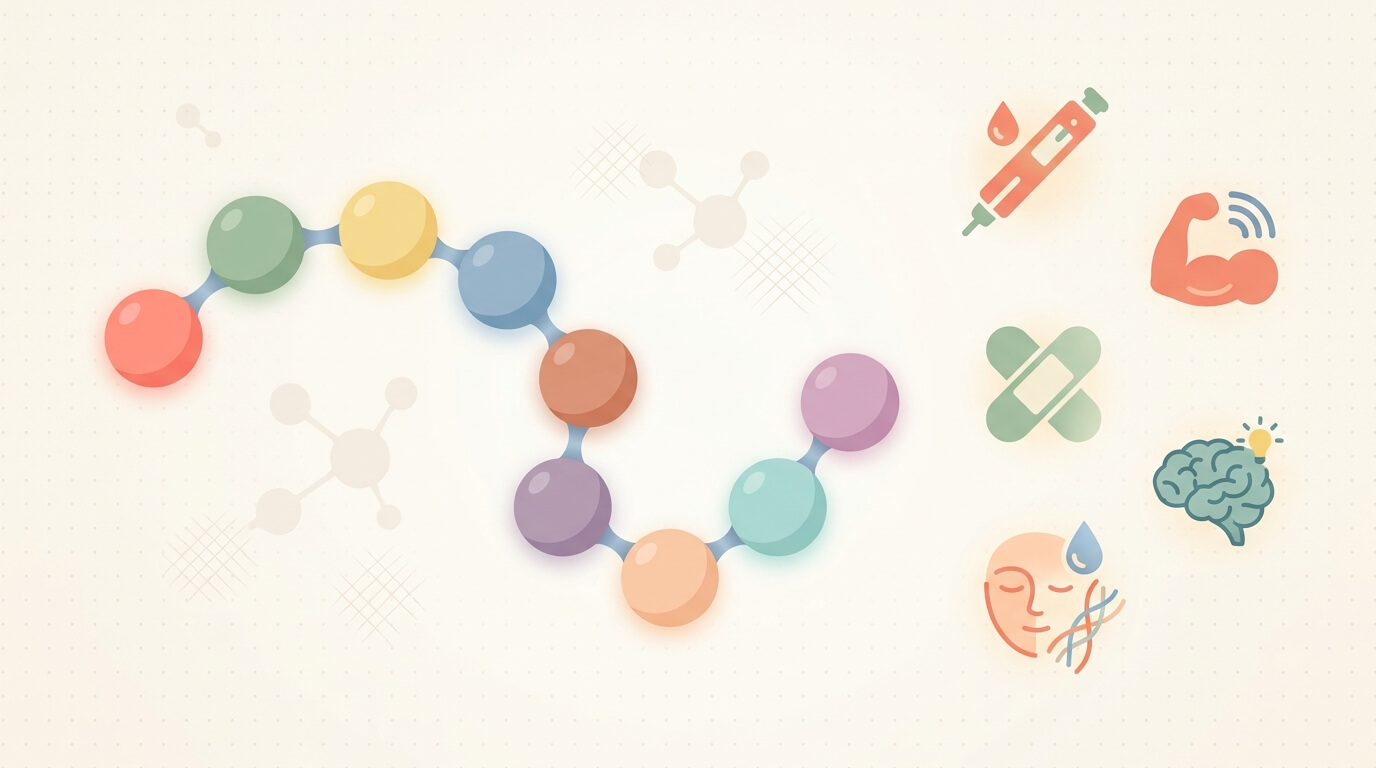
A peptide is a short chain of amino acids linked together. Amino acids are the small building blocks that make up everything from your hair to your blood. Most peptides are between 2 and 50 amino acids long, though the upper boundary is fuzzy.
The way amino acids link is called a peptide bond. Two amino acids joined by one bond is a dipeptide. Three amino acids is a tripeptide. Anything longer than that is just called a peptide, until the chain gets long enough to be called a protein.
Your body uses peptides for almost everything. Insulin, the hormone that controls your blood sugar, is a peptide. Oxytocin, the hormone released during childbirth and bonding, is a peptide. The hormone that tells your brain you are full after a meal (GLP-1) is a peptide. Even some of the molecules involved in skin repair, mood, and sleep are peptides.
Peptides vs proteins vs amino acids
The word “peptide” makes more sense once you see how it fits between the smaller and bigger versions of the same chemistry.
| Term | Size | Example | What it does |
|---|---|---|---|
| Amino acid | 1 unit | Glycine, lysine, tryptophan | Building block; some have signaling roles |
| Peptide | 2 to 50 amino acids | Insulin, oxytocin, semaglutide, BPC-157 | Hormones, signals, repair, growth |
| Protein | 50+ amino acids, often folded | Hemoglobin, collagen, antibodies | Structure, transport, immune defense, enzymes |
The cutoff at 50 amino acids is a loose convention, not a hard rule. Some chemists use 100 as the cutoff. Some count by molecular weight rather than amino acid number. The practical point is that peptides are short and proteins are long, and the difference matters because shorter chains behave differently in the body.
Two big differences come from the size. First, peptides are usually not folded into a complex three-dimensional shape the way proteins are, which means their function depends more on the sequence and less on the shape. Second, peptides break down in the digestive tract more easily than proteins do, which is why most peptide drugs have to be injected rather than swallowed.
Where peptides come from
Peptides come from three sources. Your own body, other living organisms, and a chemistry lab.
The peptides your body makes are called endogenous peptides. There are thousands of them, and they handle messaging, repair, immune defense, and almost every other process. Insulin, glucagon, oxytocin, vasopressin, GLP-1, and ghrelin are all peptides your body produces.
The peptides that come from other organisms are called extracted or natural-source peptides. Cerebrolysin, used in many countries for stroke and dementia, is a mixture of peptides extracted from porcine brain tissue. Some collagen peptides in supplements come from cow or fish skin.
The peptides that come from a lab are called synthetic peptides. Almost every modern peptide drug is synthetic, including semaglutide, tirzepatide, sermorelin, BPC-157, GHK-Cu, and TB-500. Synthetic peptides are made one amino acid at a time on a chemical assembly process called solid-phase peptide synthesis, developed by Bruce Merrifield in 1963.
The major peptide families people are asking about
When people search “peptides” in 2026, they are usually asking about one of five families. Each family is built around a different mechanism and a different use case.
| Family | What it does | Common examples | Typical regulatory status (US) |
|---|---|---|---|
| GLP-1 receptor agonists | Lower blood sugar; reduce appetite; weight loss | Semaglutide, tirzepatide, liraglutide, dulaglutide | FDA-approved as brand drugs (Ozempic, Wegovy, Mounjaro, Zepbound, Victoza, Trulicity) |
| Growth hormone peptides | Stimulate the body’s own growth hormone release | Sermorelin, tesamorelin, ipamorelin, CJC-1295 | Mixed: sermorelin and tesamorelin are FDA-approved; others are restricted |
| Healing and recovery peptides | Animal studies show tissue repair, gut and joint healing | BPC-157, TB-500 | Category 2 list; US compounding restricted |
| Anti-aging and skin peptides | Skin density, hair, wound healing, copper biology | GHK-Cu, epithalon, thymalin | Topical GHK-Cu is OTC cosmetic; injectable forms restricted |
| Nootropic peptides | Focus, memory, mood, anxiety | Semax, Selank, Cerebrolysin, Noopept | Mostly not approved in the US; some category 2; some sold as supplements |
A few notes on that table. The GLP-1 family is the largest peptide drug category by sales in 2026 and is what most people mean when they say “peptide” in a weight loss conversation. The growth hormone family is older and includes some FDA-approved compounds (sermorelin, tesamorelin) alongside others that are not. The healing, anti-aging, and nootropic families are mostly research-stage in the US, though several are clinically used in other countries.
How peptide drugs are usually given
Peptides have a delivery problem. The digestive system is built to break down peptides into amino acids before they reach the bloodstream, which means most peptides cannot just be swallowed. Drug developers have to find another route.
The most common route is a shot under the skin (subcutaneous injection). This is how Ozempic, Wegovy, Mounjaro, Zepbound, sermorelin, and most research peptides are taken. The peptide goes into the fatty layer just under the skin, where it slowly enters the bloodstream.
A few peptides have made it into oral forms by adding a permeability enhancer that helps the molecule survive the gut. Rybelsus, an oral form of semaglutide, is one example. Cyclic peptides and modified peptides are easier to get into pill form than long, linear ones.
Some research peptides are given as a nasal spray, because the nasal mucosa lets the molecule reach the bloodstream and the brain more efficiently than swallowing would. Semax and Selank are both used this way. A handful of peptides, like GHK-Cu in cosmetic serums, are applied to the skin directly.
The regulatory map
The word “peptide” by itself does not tell you anything about whether the molecule is legal, safe, or accessible. The regulatory category depends on the specific peptide.
The four main regulatory buckets, as of April 2026
FDA-approved drug. The peptide has gone through full US drug approval and is sold as a brand-name medicine. Examples: insulin, semaglutide (Ozempic, Wegovy, Rybelsus), tirzepatide (Mounjaro, Zepbound), sermorelin, tesamorelin, oxytocin.
Compounded by prescription. The peptide is not a brand-name drug but is on the FDA’s category 1 bulk drug substances list, which lets US 503A pharmacies prepare it from a patient-specific prescription.
Category 2 (compounding restricted). The peptide is on the FDA’s category 2 list, which restricts US compounding pharmacies. BPC-157, TB-500, ipamorelin, CJC-1295, epithalon, and injectable GHK-Cu sit here as of April 2026. A planned reclassification announced February 27, 2026 may move many back to category 1, but the official FDA list is still pending.
Cosmetic or supplement. The peptide is sold legally as a cosmetic ingredient (topical GHK-Cu) or a dietary supplement (Noopept in some channels). The legal status varies by US state and product.
The practical effect is that two peptides can sit in completely different worlds. Semaglutide is a brand drug your insurance might cover. BPC-157 is a research chemical you cannot legally buy from a US compounding pharmacy right now. Both are peptides.
Are peptides safe?
The honest answer is “it depends on the peptide.” Calling something a peptide tells you about as much about its safety as calling something a “small molecule” tells you. The category is too broad.
For FDA-approved peptides like semaglutide, tirzepatide, sermorelin, and insulin, the safety record is the same as for any approved drug. They have known side effects, known reasons not to use them, and a formal system for reporting side effects.
For compounded peptides made by licensed US pharmacies under prescription, the safety profile depends on the molecule, the prescriber, and the pharmacy. The pharmacy is regulated, the molecule may not be on the FDA-approved list, and long-term human safety data may be limited.
For research peptides sold outside the regulated channels, the picture is more uncertain. The product quality can vary widely, the long-term human safety data may not exist, and the biology may be based on animal studies that did not transfer to humans cleanly. A real prescriber conversation matters most for peptides that fall into the research-channel category.
Common misconceptions
Three pieces of internet folklore are worth correcting before you go any further.
The phrase “peptide therapy” does not refer to a single treatment. It is an umbrella term used loosely for any clinical use of peptides, from insulin in diabetes to BPC-157 in sports recovery. When a clinic markets “peptide therapy,” ask which specific peptide and which use case.
Peptides are not all illegal. Insulin is a peptide. Semaglutide is a peptide. Sermorelin is a peptide. Each is FDA-approved or legally compounded. The illegal label gets misapplied to the entire category because some research peptides are restricted.
Peptides are also not all natural. Some are extracted from natural sources, but most modern peptide drugs are synthetic and have been since the 1960s. “Synthetic” is not a red flag; it is the standard way these molecules are made.
What to know going in
Peptides are a class of molecules, not a single product. The word covers everything from your body’s own insulin to a synthetic seven-amino-acid nasal spray developed in a Russian research institute. The right question is never “are peptides safe” or “are peptides legal.” The right question is which peptide, for which use, accessed how.
If you came to this article wondering about a specific compound (semaglutide for weight loss, BPC-157 for a torn shoulder, Cerebrolysin for cognitive recovery), the next step is the monograph for that compound. Single-compound articles cover mechanism, dosing, side effects, and 2026 access in much more detail than a category guide can.
Frequently asked questions
Are peptides the same as proteins?
Peptides and proteins are made of the same building blocks (amino acids) and joined by the same kind of bond (a peptide bond). The difference is size. Peptides are typically 2 to 50 amino acids long. Proteins are usually 50 or more amino acids and are folded into complex three-dimensional shapes. The line between the two is loose, but the practical difference is that proteins are larger and behave differently in the body.
Are peptides drugs, supplements, or something else?
Peptides can be any of those, depending on the specific molecule. Some peptides like semaglutide and insulin are FDA-approved drugs. Some are legally compounded by US pharmacies under prescription. Some are sold as cosmetic ingredients (like topical GHK-Cu). Some are sold as research chemicals. The category depends on the molecule, not on the word “peptide.”
Why do most peptides have to be injected?
The digestive system breaks down peptides into amino acids before they reach the bloodstream, which means most peptides do not survive being swallowed. Injection bypasses the gut and gets the peptide into the body intact. Some modern peptides have been chemically modified to survive oral dosing (Rybelsus, an oral semaglutide, is one example), but injection is still the most common route.
What is “peptide therapy”?
“Peptide therapy” is an umbrella phrase used loosely for any clinical use of peptides. It can mean insulin for diabetes, sermorelin for adults with low growth hormone, or off-label use of compounded peptides for recovery and anti-aging. There is no single thing called peptide therapy. When a clinic markets it, ask which specific peptide is being prescribed and what the use case is.
Are peptides safe?
The answer depends entirely on which peptide. FDA-approved peptide drugs like semaglutide and insulin have well-defined safety profiles and reporting systems. Compounded peptides have safety records that depend on the molecule, the prescriber, and the pharmacy. Research-channel peptides have variable product quality and limited long-term human safety data. Talk to your doctor before using any peptide, especially if it sits outside the regulated channels.
Do peptides build muscle?
Some peptides indirectly support muscle growth by stimulating growth hormone release (sermorelin, ipamorelin, CJC-1295). These are not the same as anabolic steroids, which act directly on muscle cells. The peptide effect on muscle is usually modest and depends on training and nutrition. None of these peptides will produce results similar to anabolic steroid use, despite what some marketing claims.
Can you eat peptides?
Some peptides survive cooking and digestion intact and may have biological effects, which is the basis of the “bioactive peptides” research area. Collagen peptide supplements are one example. Most peptide drugs do not survive the gut, however, which is why they are injected. Eating beef will not give you the same effect as a sermorelin shot, even though both involve peptides.
How are peptides made?
Modern peptide drugs are made in chemistry labs through a process called solid-phase peptide synthesis, developed by Bruce Merrifield in 1963. Amino acids are added one at a time to a growing chain anchored to a solid support, then released and purified. Some peptides are also produced through recombinant DNA technology, where bacterial or yeast cells are engineered to manufacture the peptide.
Editorial disclosure and disclaimer
Self Care Voyage is an independent editorial review site. We do not sell, prescribe, or dispense any medication. This article is educational and does not constitute medical advice. Some peptides discussed here are FDA-approved drugs; others are compounded by prescription, restricted under the FDA category 2 bulk drug substances list, sold as cosmetic ingredients, or sold as supplements. The regulatory status of peptides may change without notice, especially given the ongoing FDA reclassification announced in February 2026. Individual results vary. Talk to your doctor before using any peptide or starting any new protocol, especially if you take prescription medication, are pregnant or breastfeeding, or have a history of cancer or a chronic medical condition.
Sources
- Merrifield RB. Solid phase peptide synthesis. I. The synthesis of a tetrapeptide. J Am Chem Soc 1963;85(14):2149-2154. https://pubs.acs.org/doi/10.1021/ja00897a025
- Lau JL, Dunn MK. Therapeutic peptides: historical perspectives, current development trends, and future directions. Bioorg Med Chem 2018;26(10):2700-2707. PMID 28720325. https://pubmed.ncbi.nlm.nih.gov/28720325/
- Wang L, Wang N, Zhang W, et al. Therapeutic peptides: current applications and future directions. Sig Transduct Target Ther 2022;7:48. https://www.nature.com/articles/s41392-022-00904-4
- US Food and Drug Administration. Bulk Drug Substances Used in Compounding Under Section 503A: Categories 1 and 2. https://www.fda.gov/drugs/human-drug-compounding/bulk-drug-substances-used-compounding-under-section-503a-fdca
- US Food and Drug Administration. Drugs@FDA: FDA-Approved Drugs (semaglutide, tirzepatide, sermorelin, tesamorelin, insulin records). https://www.accessdata.fda.gov/scripts/cder/daf/
- World Anti-Doping Agency. WADA Prohibited List 2026. https://www.wada-ama.org/en/prohibited-list